
This article was originally published in the Surveyors Journal (Volume 16, Issue 1, February/March 2026), as part of the edition titled “The Real Costs of New Apartment Delivery”. It is written by Castlethorn’s Eoin Wilcox, MA MRICS MSCSI, Director of Business Information and Underwriting.
The government’s accelerating infrastructure report has brought a renewed focus to what actually enables infrastructure delivery on the ground, but challenges remain for delivering on housing targets.
Looking back over 2025, it was, in my opinion, a year of productive engagement by key stakeholders, informed by the ‘Report of The Housing Commission’ (May 2024) and the subsequent ‘next steps’ response, both of which emphasised that housing delivery requires joined-up, enabling infrastructure and delivery oversight.
In that context, the Government’s ‘Accelerating Infrastructure Report and Action Plan’ of December 2025 (the acceleration plan) sits alongside the Government’s updated infrastructure plan, namely the revised National Development Plan (NDP) and the more detailed sectoral investment plans that sit underneath it. Together, they have placed a renewed focus on what actually enables delivery on the ground. Alongside the investment programme, the acceleration plan sets out a programme of reforms intended to speed up delivery and ensure that funding translates into timely, co-ordinated outcomes. It groups 30 actions under four pillars, covering legal reform, regulatory reform and simplification, delivery and co-ordination reform, and public acceptance, with timelines, oversight and metrics for implementation. It is further broken down into detailed sub-actions and delivery milestones, particularly over 2026 (Figure 1).
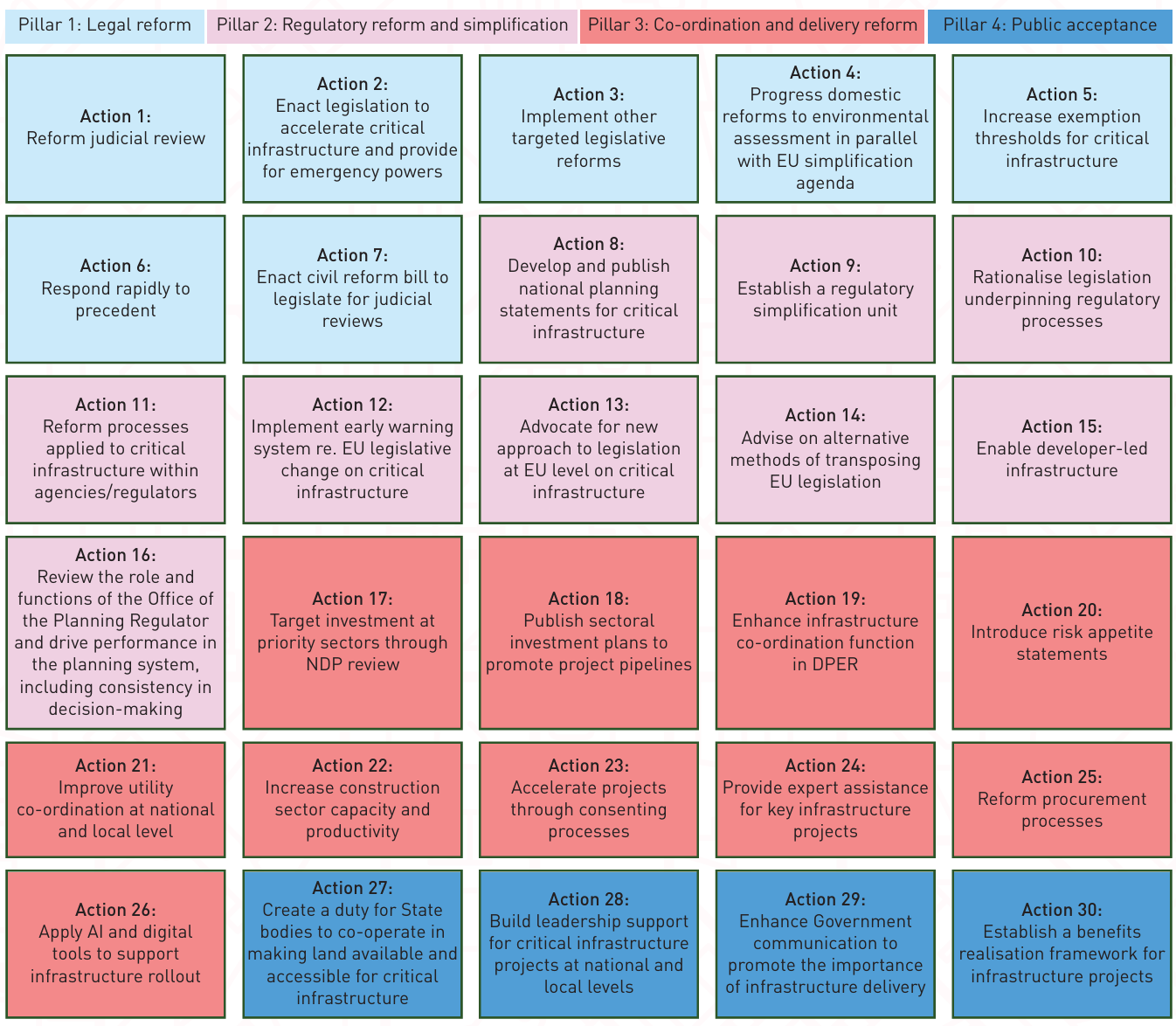
There is a lot in this acceleration plan, but in this article I will address mainly Pillar 3 (Actions 17-26): ‘Co-ordination and Delivery Reform’, focusing on utilities and connection sequencing, particularly water, wastewater and electricity. Others are of course important, but I am deliberately not dealing with them in any detail here.
Policy Context: Infrastructure Reform and Housing Delivery
In June 2025, the Society of Chartered Surveyors Ireland (SCSI), along with the Royal Institute of the Architects of Ireland (RIAI), was invited to meet with the infrastructure office created within the Department of Public Expenditure and Reform (DPER) to discuss delivery mechanisms, perceived barriers, and what additional supports might aid the delivery of critical infrastructure. This type of consultation and engagement is consistent with the approach set out in the acceleration plan. In November 2025, the Oireachtas Joint Committee on Infrastructure and National Development Plan Delivery invited the SCSI, along with the RIAI and the Irish Planning Institute (IPI), to contribute as witnesses to a Joint Committee meeting. I attended as part of the SCSI delegations on both occasions, and many of the points I set out here were woven into the SCSI submissions and discussions with these bodies. Below I map a number of the Actions to the issues raised and outline some examples.
Targeting Investment and Building Infrastructure Pipelines (Actions 17–19)
I am grouping the following Actions together: 17 ‘Target Investment at Priority Sectors through NDP Review’; 18 ‘Publish Sectoral Investment Plans to Promote Project Pipelines’; and, 19 ‘Enhance Infrastructure Coordination Function in DPER’. In summary, set out through the revised NDP and its sectoral investment plans, the Government commits to total public capital investment of €275.4 billion to 2035, including €102.4 billion in exchequer capital ceilings for the period 2026-2030, supplemented by a further €10 billion in equity and fund releases to support major projects. Within that framework, the Government identifies specific enabling investment for housing delivery, including significant investment in water and wastewater through Uisce Éireann (noting that the acceleration plan references circa €11.9 billion over 2025-2029, and associated equity support to enable delivery), €3.5 billion in equity support for electricity grid capacity (ESB Networks and EirGrid), and additional targeted investment intended to unlock housing through key transport and other enabling infrastructure. This scale of investment is significant and welcome. It will require the other pillars of the acceleration plan to work, including Pillar 1 ‘Legal Reform’, to enable physical delivery. Actions 17, 18 and 19 are intended to make the investment programme visible as a pipeline and coordinated in delivery.
Historically, Uisce Éireann has been funded, in part, on a yearly cycle – unlike ESB Networks, where grid investment programmes are planned over longer regulatory and investment periods – and this can limit forward planning with certainty to some degree. The point in practice is that even where multi-year envelopes exist, delivery still depends on sequencing, approvals, and connection programmes aligning with housing delivery schedules. Actions 17, 18 and 19 should work well together as support for multi-year capital allocations under the revised NDP, and for the sectoral investment plan for water services and water quality, as well as ESB Networks grid capacity.
Improving Utility Co-ordination in Housing Delivery (Action 21)
Action 21 is ‘Improve Utility Coordination at National and Local Level’. Uisce Éireann was required to issue confirmation of feasibility for each development that sought planning approval as part of the Strategic Housing Development (SHD) planning process, and this has continued in practice under the Largescale Residential Development (LRD) process. This can be seen as a positive early interaction by the utility provider with the landowner and delivery teams, and it helps them to assess issues that may not otherwise be established at that point.
Unlike Uisce Éireann, ESB Networks is not typically involved at planning stage with the landowner or delivery teams, and currently has a process that only truly engages with the delivery team after the grant of planning, and after naming and numbering have been confirmed by the local authority. That sequencing can mean that the first time a scheme meets an electricity capacity constraint is relatively late in the programme. This is currently under review by ESB Networks.
By way of example, we had a development that had houses standing, awaiting connection from ESB Networks, with the units sold and needing power to be completed and properly signed off, only to be told that there would be a significant (months-long) delay to receiving connection due to the need for a new substation to reinforce another part of the network. It can take up to two years from the order of a new substation to delivery. However, through constructive engagement with ESB Networks, a solution was found to minimise the impact, by redirecting a substation from another area where demand hadn’t progressed as anticipated or mapped.
In my mind, this issue came about due to two factors. Firstly, ESB Networks’ process of engagement is late in the delivery process, unlike Uisce Éireann, meaning that the lead-in time for equipment was disconnected from the on-site delivery of homes. Secondly, the heatmaps used by utilities providers are overly dependent on local authority input and do not adequately incorporate what is actually being delivered by construction delivery partners. To support this, the use of infrastructure heatmaps should be expanded beyond local authorities to include input from delivery teams where programmes are committed and genuinely progressing to commencement, enabling clearer identification of constraints, better sequencing, and more transparent decision-making.
Action 21 is intended to target issues like this by improving co-ordination at national and local level through formal engagement structures, so that constraints are surfaced earlier and connection programmes can be sequenced in step with delivery programmes.
Expanding Construction Capacity and Productivity (Action 22)
This targets increasing construction sector capacity and productivity by advancing the actions of the construction industry capability group, streamlining the processes around visas and work permits to support global recruitment, expanding the capacity and output of existing vocational and educational institutions, and improving the use of modern methods of construction (MMC) and digitalisation. This is welcome, as it supports the wider capacity of the construction industry, and the professional and specialist resources required for delivery.
Streamlining Procurement and Consenting Processes (Actions 20, 23 & 25)
Again, I am grouping the following Actions: 20 ‘Introduce Risk Appetite Statements’; 23 ‘Accelerate Projects through Consenting Processes’; and, 25 ‘Reform Procurement Processes’. There are a number of objectives within these actions, but I wish to highlight the objective of further standardising procurement. According to the acceleration plan, a more centralised approach to procurement in critical infrastructure and works projects will be adopted within specific sectors and in the local authority sector through the work of the Local Government Operational Procurement Centre (LGOPC). This objective links with Action 23 (accelerating projects through consenting processes) and Action 20 (risk appetite statements) in that consenting and approvals can be streamlined, and proportionate oversight can be applied earlier, to avoid sequential delay where a project is already clearly on the critical path. In practice, rigid funding and procurement frameworks can make it difficult for public and semi-State bodies to respond flexibly or engage effectively with private sector delivery partners, and there is merit in expanding and streamlining procurement approaches, including through the introduction of clearer risk appetite statements across the system. Currently there is a prevailing reliance on traditional public procurement methods, which can be overly prescriptive and risk averse. Broadening the use of alternative delivery models, such as design-and-build and competitive dialogue, can enable earlier engagement between semiState bodies and industry actors, and lead to faster, more efficient outcomes, where appropriate.
While the following scenario would easily fall under Pillar 2, Action 15 (to enable developer-led infrastructure), I use it as an example of procurement process impact. Uisce Éireann allows on-site infrastructure to be delivered by the delivery teams, but off-site connection works in public roads require separate processes to progress, and the self-lay process in public road delivery, while updated in June 2025, has limitations on quantum of work eligibility thresholds. One instance where I have experienced this impact was where we delivered key pumping station and water services works on site for a large development. Ultimately, these works were to be taken in charge, but we were unable to progress the off-site connection in the public road. We needed to wait for Uisce Éireann’s due process of procurement and appointment to progress, creating a disconnect between on-site delivery and final connection. While this issue, thankfully, was flagged at an early stage due to the upfront nature of the Uisce Éireann process, it nonetheless led to uncertainty for an extended period of time for the delivery team.
Using AI and Digital Tools to Improve Infrastructure Delivery (Action 26)
Action 26 is to facilitate applying artificial intelligence (AI) and digital tools to support infrastructure rollout by improving visibility of live pipelines and constraints, and by supporting clearer reporting and coordination across delivery partners – so that issues are identified earlier and decisions can be made with real-world programme information.
Translating Infrastructure Investment into Housing Delivery
In summary, the revised NDP and the sectoral investment plans set out the scale and priority of investment now committed to enabling infrastructure, while the Government’s ‘Accelerating Infrastructure Report and Action Plan’ sets out the delivery reforms intended to translate that investment into capacity and connections on the ground. The practical challenge remains converting investment into predictable, sequenced outcomes, particularly where utility engagement, approvals, and procurement processes do not align with housing delivery schedules. The proposed Actions under Pillar 3 are therefore important and welcome because they are intended to improve co-ordination, pipeline visibility, and delivery certainty at national and local level, and to reduce avoidable delay where projects are already clearly on the critical path.
As these reforms progress, their effectiveness will depend not only on investment and co-ordination, but also on continued evolution of planning reform in Ireland, ensuring that infrastructure, consenting and delivery frameworks operate in a more aligned and predictable way.