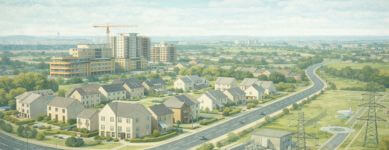
Inclusive design is reshaping Ireland’s construction industry and living experience — ensuring that new communities work for people of every age, ability and background. From footpath gradients and lighting design to accessible homes and neighbourhood layouts, developers like Castlethorn are proving that thoughtful planning can make the built environment more liveable for all.
Quietly moving the needle are women such as Castlethorn’s own Eve Wojcicka, Project Manager for Pre-Construction and Site Administration, who was the April 2024 feature of the Irish Construction Industry Magazine. She believes that inclusion begins long before a single brick is laid.
“Pre-construction is where we can make the biggest difference,” Eve explains. “Once a build starts, changes are harder and more costly. When inclusion is considered from day one, everyone benefits.”
The Case for Inclusive Design in Ireland
Ireland’s construction sector employs more than 170,000 people, yet women still make up less than 10 percent of its on-site workforce. According to SOLAS research on gender segregation, reducing occupational gender gaps could significantly expand Ireland’s skills base and help meet housing delivery targets.
Complementary analysis by SIG Ireland on women in construction notes that greater visibility of women in technical and leadership roles improves collaboration and site culture — areas in which Castlethorn is already setting a strong example.
From Policy to Practice
National planning guidance such as Ireland’s Design Manual for Urban Roads and Streets and Universal Design Principles emphasises accessibility, safety and context-sensitive layouts. At Castlethorn, these frameworks are translated into tangible design choices during pre-construction — decisions that influence everyday experiences, from how residents move around a neighbourhood to how safe they feel at night.
Wojcicka and her team aligns to these standards, reviewing:
- Lighting plans to ensure visibility on key walking routes.
- Footpath and cycle-lane widths for buggies, mobility aids and prams.
- Seating and rest areas within short intervals.
- Clear signage and wayfinding to assist people with reduced mobility or visual impairments.
- Adaptable homes with level thresholds and accessible bathrooms.
This systematic approach transforms compliance into community benefit — creating safer, friendlier streetscapes that foster independence for residents young and old.
Building Communities That Reflect Real Life
Wojcicka’s philosophy is simple: design for the full circle of life. “The mother walking with a buggy today may use a walking aid in 30 years,” she says. “If we plan with that full journey in mind, we future-proof our communities.”
This perspective informs Castlethorn’s broader sustainability vision. Every development aims to balance environmental performance with social and economic resilience. Energy-efficient construction and biodiversity planning go hand-in-hand with inclusive neighbourhood design — from adaptable A-rated homes to community hubs and shared green spaces.
Projects such as Ballymakenny Park in Drogheda, recognised with an Irish Construction Excellence Award, exemplify how pre-construction foresight can deliver lasting value for residents and local authorities alike.
Inclusion as a Performance Advantage
The McKinsey & Company report Diversity Matters Even More: The Case for Holistic Impact finds that companies with diverse executive teams are up to 39 percent more likely to outperform their peers — a significant increase from the 15 percent differential reported in 2015.
For developers, inclusion is not simply a moral or regulatory imperative but a measurable performance driver.
At Castlethorn, diverse perspectives inform decision-making across planning, procurement and delivery. Wojcicka’s cross-functional leadership — bridging compliance, design and safety — demonstrates how integrated thinking can lead to higher quality outcomes, reduced risk and stronger ESG performance.
Training and Representation
Creating lasting change means addressing representation at every level. Wojcicka mentors colleagues across Castlethorn’s sites and supports initiatives encouraging women to pursue construction careers. Her example reinforces our industry engagement and social responsibility, which include active participation in the Construction Industry Federation and the Irish Home Builders Association.
Through this engagement, Castlethorn contributes to shaping standards and policies that promote fairness and transparency — ensuring that inclusion is built into Ireland’s construction future.
The Future of Inclusive Communities
Ireland’s Housing for All strategy sets ambitious delivery targets alongside commitments to accessibility and universal design. Achieving these goals depends on developers who combine technical capability with empathy for the people who will live in their schemes.
Castlethorn’s record — from Lansdowne Place to its growing portfolio of broad mix-sites — shows that inclusive design and commercial success are not mutually exclusive. Instead, they are mutually reinforcing: inclusive design attracts buyers, strengthens community cohesion and improves long-term asset value.
“Inclusion isn’t an extra,” Wojcicka says. “It’s part of building quality homes that stand the test of time.”
Conclusion
Inclusive construction is no longer a niche concept; it is a practical framework for delivering safer, more sustainable and more successful communities. As Wojcicka and the Castlethorn team continue to integrate universal design principles into every stage of delivery, they demonstrate that designing for everyone ultimately benefits everyone.